Log #22: Jan/9/2025
- Happy New Year!
- Reorganization
- Better Map Layouts
Welcome back! It's 2025 now, by the way, which means our deadline for our project is only a few months away. I have some concerns about our project. But first, what I did this week!
Our first day back was not the most productive by any stretch, but I showed off some work on our game's level layout I had done over the New Year, and my team recieved it really well. I immediately told myself I would do more level design everyday, but I have sense failed to keep that up...
Initially, I mostly spent time trying to organize some of the ideas my fellow designer had written up. Later, I also did some work writting story details for our project.
This week I also tackled reorganizing our art models' files in Unreal Engine. I got to learn about how Unreal creates redirects when you move things between folders in order to stop references from breaking. If you want to reorganize files, I recommend you backup your project somehow and look into how Unreal deals with references and redirects (initially I broke things, so I had to do a quick google).
Now for my main concerns:
I "feel" like I've been procrastinating. To put it another way, I constantly feel afraid to "think". It's as if I don't want to take the project head-on and really dig into the meat of what the rest of the team needs from a designer and project manager. Frankly, I find the idea of planning the project good scary. Unfortunately, I've been putting my planning off, and have not been able to steer my team in the most efficient way.
I worry that I am going to lead the project to simply running out of time, and we wont be able to pull all of our projects components together. The longer I wait to plan things, the less time we have to work on the game.
And on that note, on to the...
MATH SEGMENT: Numbers and Quantity (Coordinate Space Transforms)
I got some good level design done for our project. This involved scaling cubes to make walls, and using the assets our artists had made to decorate the world.
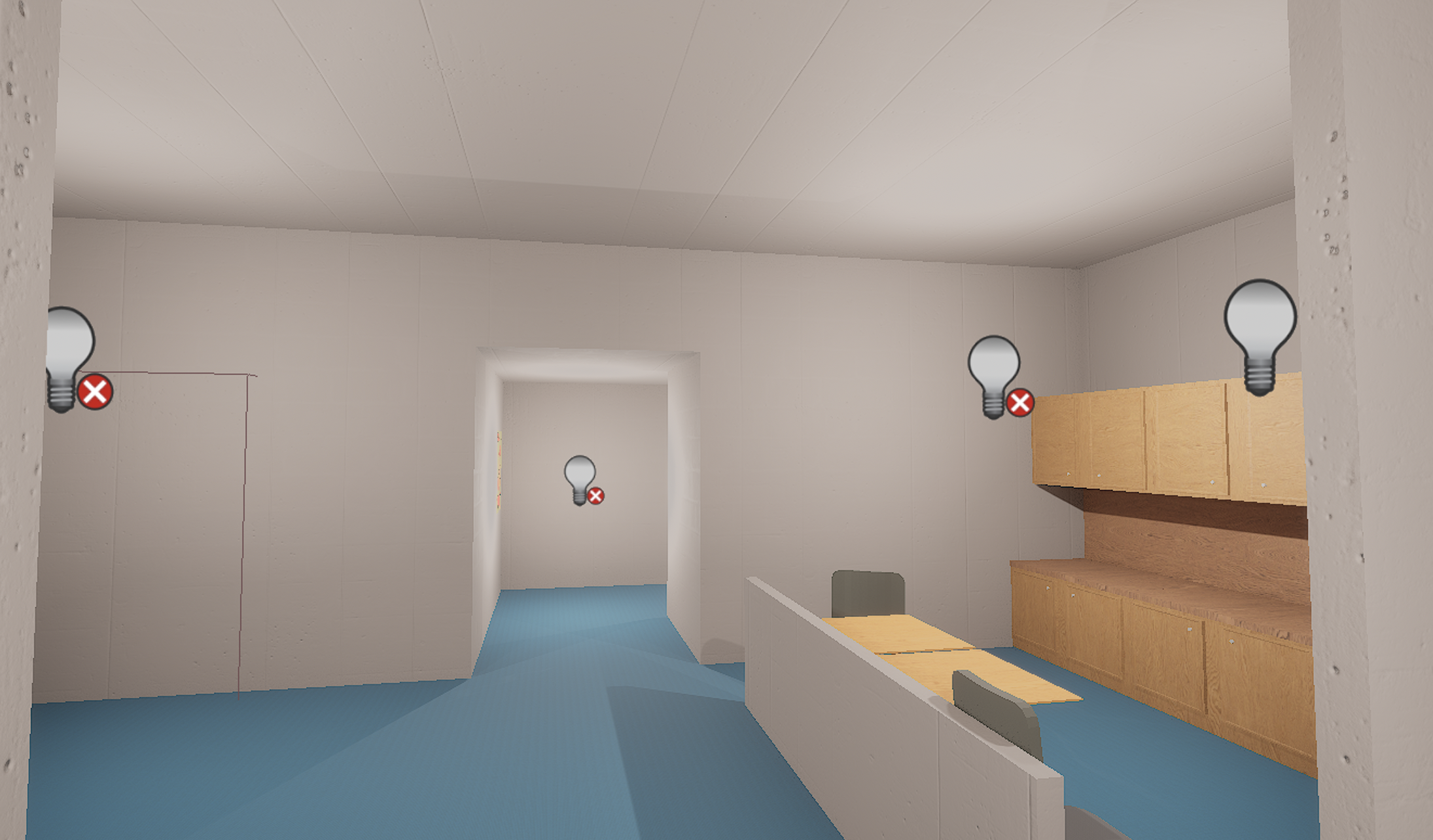
A "break room" in our game
Building this was simple, it just took time. Scaling a wall is easy if you start with a 1 x 1 x 1 meter cube (to make it 50cm, you just scale it by 0.5).
Additionally, a cool feature in Unreal is that you can "attach" assets together, allowing you to scale multiple things by just scaling the base that the others are attached to.
However, this produced unexpected consequences. Without thinking, I would rotate everything including the base's sub-pieces that were attached. This would create a strange result where some pieces would over-rotate. My theory is that, because I was rotating both the base and its sub-parts, the sub-parts would be dubly rotated, once from the base, and once because I had selected those sub-parts as well.
Moral of the story: be careful how transformations are applied when an asset is connected to others.
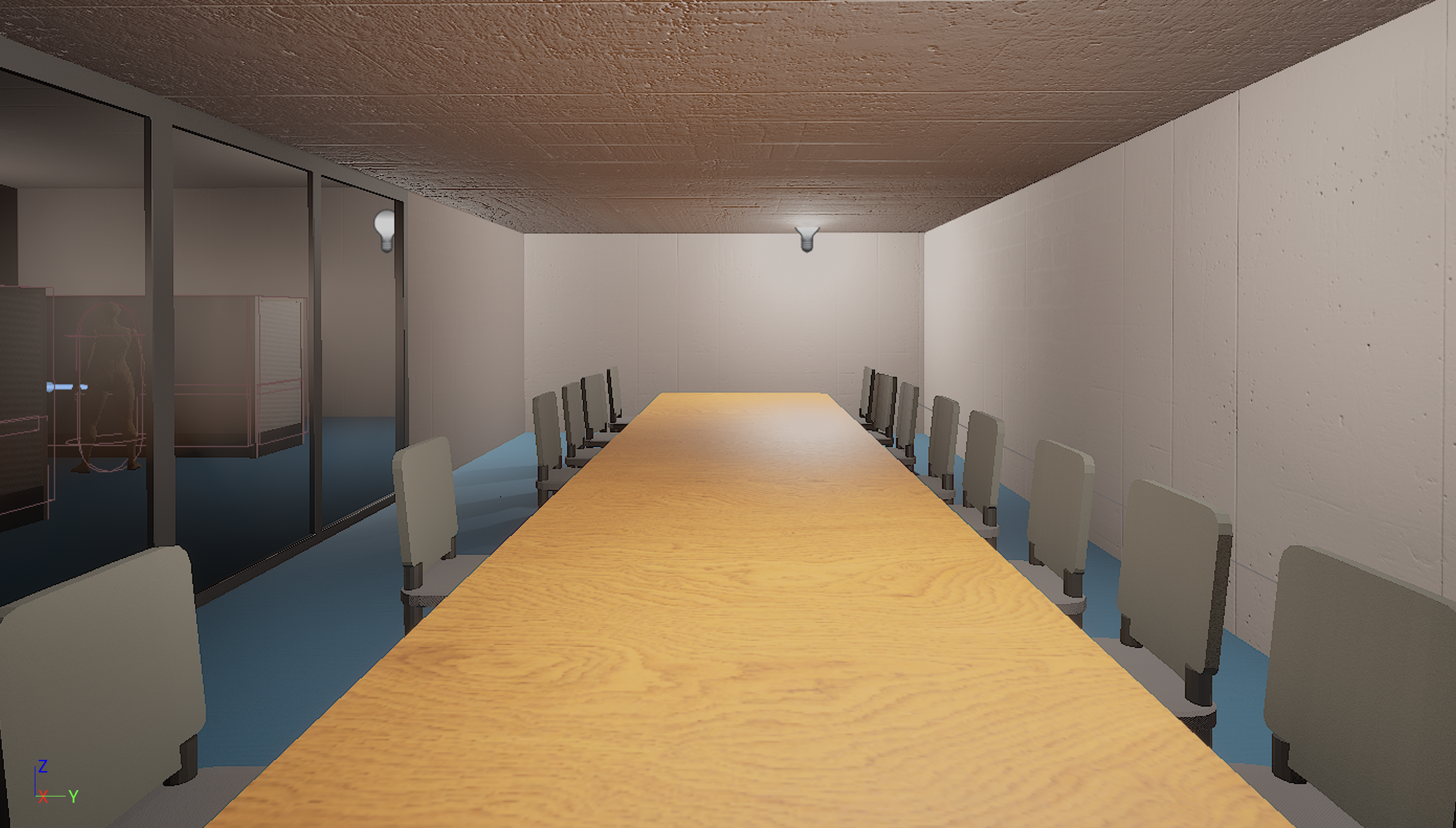
Check out our artist's models which are decorating this break room!
I also took special detail to make sure that the proportions of the hallways felt natural. Despite how actual hallways are sized, I landed on scaling our in-game hallways at 210 x 300 meters. Even though real-life hallways seem to be thinner than this, in a video game, the camera and fast movement can make spaces feel more claustrophobic than they do in real life.
MATH SEGMENT: GEOMETRY
We'll take a brief detour from our typtical video game questions and talk about a real-world problem that came to my attention.
Not long ago, a friend of mine posed an interesting question: when trying to fit a wood plank of a certain width inside of a square, they were never sure at what angles to saw off the ends of the wood plank.
In practice, one could line the plank up with the square, and trace lines where they needed to cut. However, the question of how to take a set square and plank width, and then determine how to cut that plank to make it fit in a square, left me puzzled, -I did not know how to calculate this!
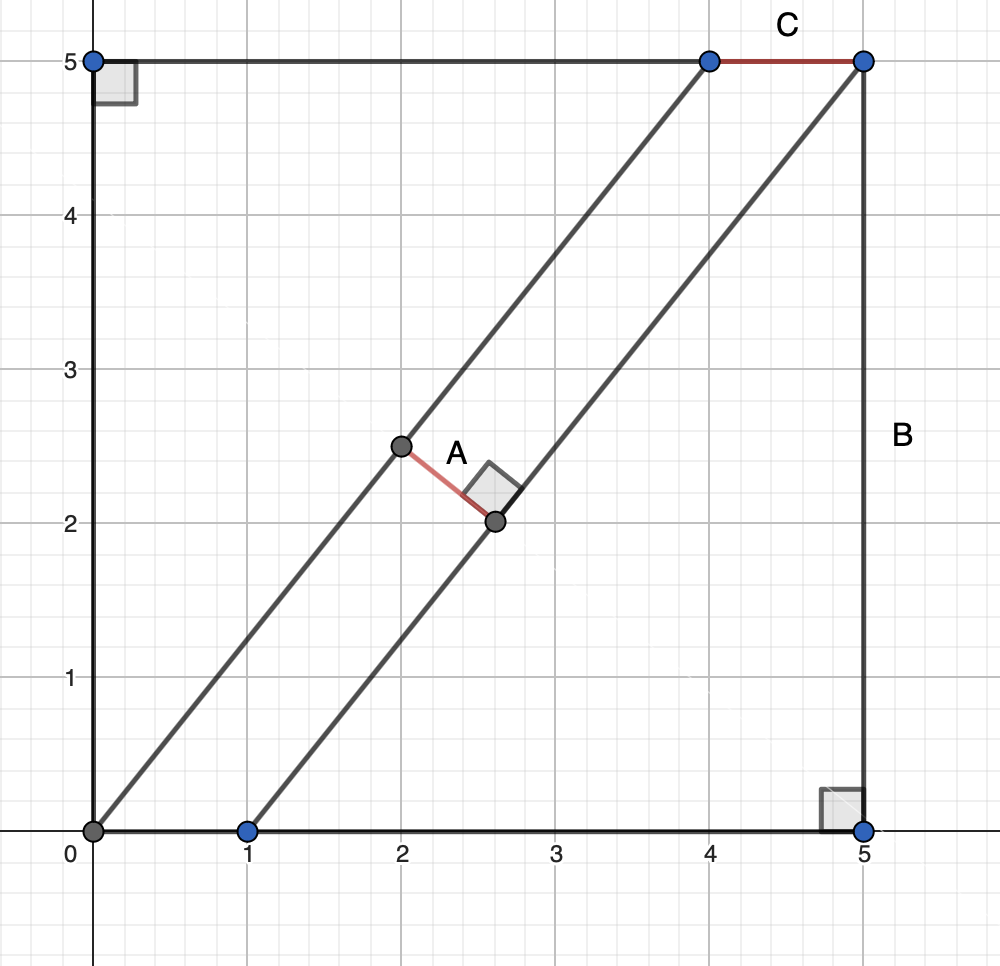
An example of the problem we're trying to solve
Another way of getting at the same question, but thinking about it in terms of the lengths of line segments, is to ask, Given the side length of a square ('B' in the above image), as well as the length of a plank with parallel sides (represented 'A'), if both sides of the plank intersect opposite corners of the square, what is the length of the cross section at the plank and the edge of the square ('C')?
Interestingly, when I create real exmaples, I can find answers. For example, when our square has a side length of 5, and the cross-section of the plank and square ('C') is 1 long, then the beam width is (5*sqrt(41))/41 (I have validated this with Geogebra).
One of my friends has spent lots of time messing with angles to find out how to solve these types of problems, but I've been more interesting in trying to create situations where I can find the answers, and then hoping to find a pattern.
And that is where I'm left today. If find the time, I would like to continue solving this problem, further marveling at the complexity that arises when putting things in squares.
If you have ideas, feel free to contact me with email at the bottom of this page.
And... that's all for now, folks! Thank you for taking the time to read my blog!
-Luke Knotts